What to Do If You're Drowning in BNPL Debt: A Step-by-Step Guide
By Jason Wilcox
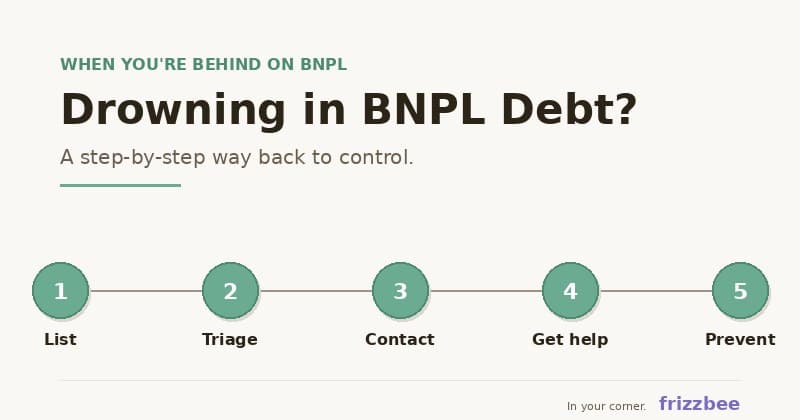
If you opened this article, you probably already know the feeling. You are not sure exactly how many Buy Now Pay Later plans you have active right now. You know the due dates are clustered around payday. You are checking your bank account before each automatic payment hits, hoping there is enough to cover it. Sometimes there is not.
You are not alone. According to LendingTree 2026 BNPL survey, 41% of BNPL users paid late at least once in the past year, up from 34% the year prior. The CFPB January 2025 report found that 63% of BNPL borrowers had multiple loans active at the same time. This is one of the most common financial situations in America right now, and it is nobody fault but the design of the products themselves.
This guide is for people who are behind, stretched thin, or worried they are about to be. The good news is that you have more options than you think — and the BNPL providers themselves have programs specifically built for this, even though they do not advertise them at checkout.
First, the honest self-assessment
Before you panic, get a clear picture of where you actually are. There is a difference between being stressed about BNPL and being in real trouble.
You are probably overextended if any of these are true. You have missed a BNPL payment in the last 60 days. You have taken out a new BNPL plan in the last month to cover an expense you could not otherwise afford. You are juggling four or more active plans across multiple providers. Your total monthly BNPL payments exceed 10-15% of your take-home pay. You have been hit with at least one bank overdraft fee in the past 90 days caused by a BNPL auto-debit.
If two or more of those describe you, you are not stressed — you are overextended. Treat it like a real problem, not an annoyance. The fix is not more discipline. The fix is a system.
Step 1: Get every plan on one page
This is the single most important step, and most people skip it because it is uncomfortable.
Open every BNPL app you use. Write down each active plan: the merchant, the remaining balance, the next payment date, the amount of that payment, and which bank account or card it auto-debits from. Do not estimate. Do not round. Get the actual numbers.
If this takes you 20 minutes, you have too many plans. That is data, not a judgment.
Add up the totals. What is your total BNPL balance right now? What do you owe in the next 7 days? The next 30? Compare those numbers to your next paycheck. If next month BNPL payments exceed what you will have available, you have a math problem, not a willpower problem — and math problems have specific fixes.
Frizzbee was built specifically for this — it pulls every BNPL plan across every provider into a single dashboard so you can see the total at a glance, with reminders before each payment. If you would rather use a spreadsheet, that works too. The point is having one source of truth.
Step 2: Triage — which plan to deal with first
For credit card debt, the standard advice is to attack the highest-interest balance first. BNPL is different.
For BNPL, prioritize in this order. First, any plan whose next payment date is in the next 3-5 days. Late fees and overdraft cascades are the immediate fire — put them out before doing anything else. Second, any longer-term plan that is accruing interest (Affirm Pay Monthly at 28%, Klarna Pay Monthly, Sezzle Pay Monthly). Even though it is not the biggest balance, the daily interest is bleeding you. Third, plans with the highest late fee risk — Sezzle has the highest late fees (up to $16.95 per missed payment) and Zip charges $5-$10 depending on state. Last, the smallest remaining balance you can knock out completely in one or two payments. Closing a plan to zero is psychologically and financially valuable — it removes a tracked date and an auto-debit risk.
This is sometimes called the "snowball" method, and for BNPL specifically it works better than the avalanche method. The average BNPL plan balance is around $760 (per Morgan Stanley data), and Pay-in-4 plans complete in six weeks. Getting plans fully closed reduces your active count, your scheduled debits, and your tracking burden faster than chasing percentage points.
Step 3: Contact the providers — they have hardship programs
This is the part most people do not know about, and it is the most powerful tool you have. Every major BNPL provider has a financial hardship program. Most of them will pause late fees, extend due dates, restructure your plan, or some combination — but only if you contact them.
The magic phrase to use, in writing if possible, is: "I am experiencing financial hardship and need to discuss my repayment options." That specific language triggers their hardship workflow, which is a different process than regular customer service.
Klarna. Klarna has a formal financial hardship support program in the US. Contact them via the in-app chat or service@klarna.com, or call their customer service. They offer a one-time payment extension feature directly in the app for some plans. For deeper hardship, ask about their Customer Recovery Programme, which can pause late fees and restructure payments. Klarna will generally waive a first-time late fee on request if you reach out before or right after it hits.
Afterpay. Afterpay has one of the most developed hardship policies in the industry. Submit via their secure hardship form or in-app Help. They have a dedicated team trained to handle this and will work with you on a new payment plan. Once you are in their hardship program, your account is paused (no new purchases) until you are caught up. Late fees are typically frozen during the arrangement.
Affirm. Affirm is the unusual one here — they do not charge late fees at all, ever. But on longer-term Pay Monthly loans with APR, interest continues to accrue if you are late, and a 30-day delinquency does get reported to Experian and TransUnion. Contact Affirm customer service through the app or helpcenter.affirm.com to ask about hardship options. Some users have been offered payment deferrals of up to six months on longer-term loans.
Sezzle. Sezzle automatically pauses your account after a missed payment, which is annoying but works in your favor — you cannot dig the hole deeper. They offer flexible payment reschedules. Contact shoppersupport@sezzle.com or support@sezzle.com. Sezzle has the highest late fees in the industry (up to $16.95 per missed payment plus a failed payment fee up to $6.95), so getting these waived is especially valuable.
Zip. Zip has confirmed publicly that it "will always make an effort to work with a customer that is experiencing hardship." Contact them through the in-app help or customer service channels. Be specific about your situation.
PayPal Pay Later. PayPal does not have a published BNPL-specific hardship program, but their general customer service can pause payments and discuss options. Call PayPal customer service or use their secure message center.
For all of them, the same rules apply. Reach out before you miss the payment if possible — proactive contact gets dramatically better outcomes than reactive contact. Be clear about your situation (job loss, medical emergency, family crisis, whatever it is). Ask for the specific outcome you want: a pause, a fee waiver, a new payment plan, a reduced minimum. And get any agreement in writing — confirm via email or message so you have a record.
Step 4: Free help from a credit counselor
If you have contacted the providers and you are still stretched, the next step is a nonprofit credit counselor. This is free, it does not hurt your credit, and it is specifically designed for people in your situation.
The National Foundation for Credit Counseling (NFCC) is the largest nonprofit credit counseling network in the US, founded in 1951, with member agencies in every state. Call 1-800-388-2227 for a free initial consultation. An NFCC-certified counselor will review your full financial picture in a 30-60 minute session and build a personalized action plan. They can also contact your lenders directly on your behalf to negotiate.
One honest caveat. Traditional Debt Management Plans (DMPs) — where a counseling agency consolidates your payments into one and negotiates lower interest — usually require a minimum total debt amount, often $7,500 or more. The average BNPL balance is around $760, so BNPL alone often does not hit those minimums. But the NFCC has spoken specifically about BNPL — their spokesperson Bruce McClary has noted that BNPL debt can sometimes be folded into a DMP depending on the provider, and even when it cannot, a counselor can still help you build a budget, prioritize payments, and contact each BNPL provider hardship program directly. The counseling itself is free regardless.
Step 5: What NOT to do
These are the moves that turn manageable BNPL debt into a real spiral.
Do not open a new BNPL plan to pay off an old one. It feels like cash-flow management. It is actually digging the hole sideways. You have not reduced your debt — you have just moved it to a new due date and reset the clock.
Do not use a payday loan or cash advance app. Payday loan APRs frequently run 300-400%. Cash advance apps may not call themselves payday loans, but the effective cost — subscription fees, expedited transfer fees, tips — often pencils out similarly. You will be in worse shape next month, not better.
Do not ignore a collections notice. If a BNPL debt has been sent to collections, the clock is now running on credit damage. A collections account stays on your credit report for seven years. Open the letter. Call the collector if you can verify the debt is real. Ask for a payment plan or settlement. Even small payments to a collector are better than silence.
Do not cancel your bank auto-debit authorization without talking to the BNPL provider first. This sounds like a way to stop the bleeding, but it usually triggers immediate late fees plus failed payment fees and can accelerate the account to collections. Contact the provider, request a payment pause through their hardship program, and let them stop the debit on their end.
Do not avoid checking the app because looking at the number is stressful. The stress does not reduce the balance. Pulling up the actual numbers is the first move toward fixing it. Frizzbee is built specifically to make this less painful — one screen, all your plans, no hunting through individual apps.
The longer game: don't end up here again
Once you are back to even, the goal is to never be back where you started. Three rules that move the needle the most.
Cap yourself at two active BNPL plans at any time. The CFPB data shows that the late payment rate climbs sharply once a user has four or more active plans. Two is a manageable number to track. Four is a job.
Keep a $100-200 buffer in your auto-debit account. This single change prevents the $35 overdraft cascade that turns missed BNPL payments into multi-fee disasters. If you cannot keep $100 in your checking account permanently, BNPL itself probably is not safe for you right now.
Use a system that shows you the total, not just the next payment. Whether that is a spreadsheet, a calendar, or Frizzbee, you need to be able to answer "How much do I owe in BNPL right now?" in under five seconds. If you cannot, the next pile-up is just a matter of time.
The bottom line
You are not the only person who got here. The numbers say one in four BNPL users paid late last year and 63% have multiple plans running at the same time. The providers know this. The CFPB knows this. There are programs in place for exactly this situation.
The single hardest step is the first one — actually opening every app, writing down every number, and seeing the total. Once you have done that, everything else is just a sequence: triage, contact providers, ask for the hardship program by name, use the NFCC if you need them, and avoid the moves that make it worse.
You are not behind because you are irresponsible. You are behind because the system is designed to make staying ahead invisible. The fact that you are reading this means you are already doing the right thing.
Sources
This article uses data from the following primary sources, verified as of May 2026.
Consumer Use of Buy Now, Pay Later and Other Unsecured Debt (January 2025) — simultaneous loan data and borrower demographics.
Federal Reserve, Survey of Household Economics and Decisionmaking (2024) — late payment rate and BNPL adoption.
LendingTree, Buy Now Pay Later Survey 2026 — 41% late payment rate.
National Foundation for Credit Counseling — debt counseling availability and BNPL guidance from NFCC spokesperson Bruce McClary, via CNBC Select coverage.
Klarna Financial Hardship Support — klarna.com/us/financial-hardship-support.
Afterpay Hardship Policy — help.afterpay.com.
Affirm Help Center — helpcenter.affirm.com.
Sezzle support — shoppersupport@sezzle.com.
Consumer Reports comparison of BNPL hardship policies — confirms Zip hardship stance.
FDIC consumer guidance on overdraft and NSF fees — typical $35 overdraft fee amount.
*About the author: Jason Wilcox is the founder of Frizzbee, a consumer advocacy app that helps Buy Now, Pay Later users track every plan in one place, avoid late fees, and dispute charges they did not agree to. He built Frizzbee after watching the BNPL industry grow into a major source of consumer debt without the consumer protections that come with credit cards. For media inquiries, contact jason@frizzbee.co.*