Klarna vs Affirm: Which BNPL is Better in 2026?
By Jason Wilcox
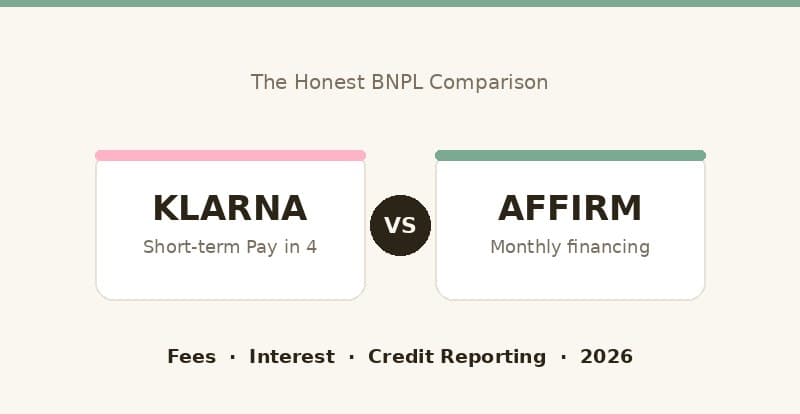
Klarna and Affirm are two of the biggest names in buy now, pay later — but they are not really built for the same thing. Most comparison articles treat them as interchangeable. They are not. Understanding the difference is the whole point of choosing well.
This is an honest, side-by-side look at Klarna and Affirm in 2026: how each one works, what they cost, how they touch your credit, and which one fits which situation.
The Core Difference
Here is the single most useful thing to understand before anything else.
Klarna is built around short-term BNPL. Its headline product is Pay in 4 — four interest-free payments over six weeks. It also offers Pay in 30 (pay the full amount within 30 days) and longer financing for bigger purchases. But the center of gravity is short-term, everyday spending.
Affirm is built around installment financing. You can split a purchase into 4 interest-free payments, but Affirm's real focus is longer monthly plans — 3, 6, 12, 24 months and beyond — for larger purchases like electronics, furniture, or travel. It behaves more like a point-of-sale loan.
So the honest framing is not "which app is better." It is "which app is built for the purchase in front of you." A 60 dollar pair of shoes and a 1,800 dollar laptop are different problems.
Fees and Interest
This is where the two genuinely diverge.
Late fees. Affirm does not charge late fees on any of its products — ever. Klarna charges up to 7 dollars per missed installment on Pay in 4, applied after a grace period, with total late fees capped at 25 percent of the order value. If you have missed BNPL payments before, that difference matters.
Interest. Both Pay in 4 products are interest-free when you pay on time. For longer financing, Klarna's rates vary by creditworthiness and term — from 0 percent up to roughly the mid-30s percent APR. Affirm's run from 0 percent to 36 percent APR. The actual rate you get depends on the merchant, the purchase amount, and your credit. Both providers show you the total cost in dollars before you commit, which is genuinely useful — no surprise interest.
The takeaway: Affirm wins on late fees because it has none. On interest, the two are close, and the rate you personally see depends far more on the specific offer than on the brand.
Credit Score Impact
This is the section most comparisons get wrong, so here is the accurate 2026 picture.
Affirm reports all of its products — including Pay in 4 — to Experian and TransUnion. Every payment, on time or late, can appear on your credit report. That cuts both ways: responsible use can help build history, and missed payments can hurt you. Affirm does not report to Equifax.
Klarna runs a soft credit check for Pay in 4 and Pay in 30, which does not affect your score. Klarna's standard Pay in 4 generally does not affect your credit score. Its longer-term financing is reported to TransUnion and Experian. Klarna does not report to Equifax.
The practical difference: with Affirm, even a small Pay in 4 purchase is now part of your credit picture. With Klarna, standard Pay in 4 generally stays off your score. If you want BNPL activity to count toward building credit, Affirm does more of that. If you would rather keep small installment purchases separate from your credit file, Klarna's standard Pay in 4 does that.
One thing that is true for both: if a debt goes unpaid long enough to reach collections, it can land on your credit report regardless of provider.
Spending Limits
Neither provider gives you a fixed credit line. Both evaluate each purchase individually based on your history, the merchant, and the amount.
Klarna's Pay in 4 is generally available for purchases roughly in the 35 to 2,000 dollar range, with the exact ceiling depending on your account. Affirm's range is wider because of its financing focus — Pay in 4 is for smaller purchases, while its longer financing can reach into the thousands for qualified buyers.
If you are financing something genuinely expensive, Affirm's higher ceiling is the practical advantage.
Which One Should You Use
Here is the honest decision guide.
Choose Klarna if you are mostly making everyday-sized purchases, you want short-term Pay in 4 or Pay in 30 flexibility, and you would prefer that standard Pay in 4 activity stay off your credit score.
Choose Affirm if you are financing a larger purchase over several months, you want zero late fees as a safety net, or you specifically want BNPL activity reported so responsible payments can build credit history.
And the most honest answer of all: many people end up using both, because they solve different problems. That is fine — as long as you can see the full picture. The real danger with BNPL is not any single plan. It is losing track of how many plans you have, across how many providers, with payments landing on different dates.
That is exactly the problem Frizzbee was built to solve. Frizzbee tracks every BNPL plan from every provider — Klarna, Affirm, Afterpay, and the rest — in one dashboard, with reminders before every payment so nothing slips. If you are using more than one BNPL service, seeing it all in one place is the difference between BNPL being a convenient tool and BNPL becoming a problem.
Whichever provider you choose, the smartest move is to know exactly what you owe, and when.