Why BNPL Providers Don't Share Your Data
By Jason Wilcox
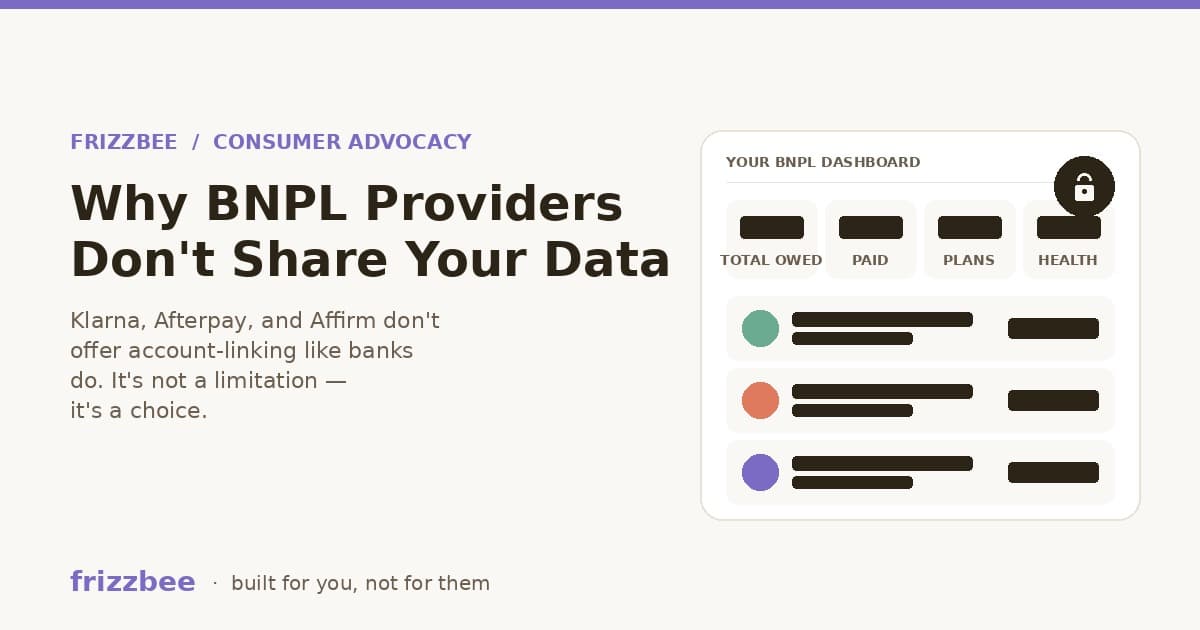
Your bank is open. Your BNPL is closed.
That's not an accident — and over the past year, it's gotten worse, not better.
If you've used Klarna for running shoes, Afterpay for a hotel, and Affirm for a couch — three plans, three providers, three apps you have to check separately, three sets of due dates to track on your own — you've already run into the problem. There's no unified view. No API you can plug into. No way to see what you owe across providers without logging into each one and writing it down on paper.
When someone asks why, the answer they usually get sounds technical. The technology isn't there yet. APIs don't exist for consumers. Regulation hasn't caught up.
That answer is not exactly a lie. But it's not the truth either.
The truth is: it's a choice.
They have APIs. Just not for you.
Klarna has APIs. So does Afterpay. So does Affirm. They've all built sophisticated developer platforms — for merchants. The Klarna Merchant Portal gives a Shopify store real-time visibility into every transaction tied to its products. Afterpay's Partner API hands retailers customer-level plan data for fraud detection, marketing, and inventory.
What none of them have built is the same thing for the customer.
This is a deliberate, expensive omission. Building a consumer-facing API is not technically difficult — the merchant infrastructure already exists. The data is already structured. The auth flows are already built. Exposing it to the people who actually owe the money would take a small engineering team a quarter, maybe two.
It hasn't happened in fifteen years of the industry's existence. It's not on any provider's roadmap. There's a reason for that.
A user who can see everything spends less
Here's where it gets uncomfortable.
When debt becomes visible, behavior changes. People slow down. They make different choices. They pay things off instead of taking on more. This is settled consumer-finance research, and the providers know it as well as anyone.
The opposite is also true. A user who has to check four different apps to see what they owe usually doesn't. Most don't even check one. They rely on each provider's default reminders — helpful, but isolated — miss a payment here and there, get hit with a late fee, and move on.
Late fees are not a side effect of the BNPL business model. They are part of it.
When Klarna filed its F-1 prospectus with the SEC in March 2025, it disclosed the breakdown of its revenue. Klarna doesn't call them "late fees" in that filing. The corporate term Klarna uses is "reminder fees." Those reminder fees made up 16% of Klarna's transaction and service revenue in 2024, up from 12% in 2022 — roughly $342 million in late fees in a single year, and a growing share of the company year over year.
The euphemism is itself worth pausing on. A "reminder fee" sounds like a small administrative charge for a courteous prod. It's actually a $7-to-$35 penalty that triggers when you miss a payment. Klarna chose the language deliberately.
Afterpay reports late fees too. Affirm makes most of its money on interest, but late fees on its zero-interest plans still contribute meaningfully. Across the industry, late fees fund a non-trivial slice of the operation. For the per-provider breakdown, see our guide to BNPL late fee policies.
If every BNPL user could see every plan in one place, those numbers would drop. Awareness drops late payments. Side-by-side visibility surfaces "wait, I'm carrying $450 across these four apps" moments that change behavior in ways the providers don't want.
That awareness costs them money. So they don't build it.
What about regulation?
Here's where the story has gotten dramatically worse over the past year — and where the case for consumer self-help has gotten stronger, not weaker.
In banking, you have a right to your data. The Consumer Financial Protection Bureau's Section 1033 rule, finalized in October 2024 under the Dodd-Frank Act, requires banks to give consumers — and the apps consumers authorize — access to their financial data. That's the rule that makes Plaid possible. That's why your budgeting app can see your checking account.
In May 2024, the CFPB went a step further and issued an interpretive rule classifying BNPL providers as "credit card issuers" for limited purposes. They'd have to handle disputes and refunds the same way credit cards do. It wasn't full data access, but it was a real step toward parity.
Both rules are now being unwound.
The Financial Technology Association sued the CFPB the same month the BNPL interpretive rule was issued. In May 2025, the CFPB withdrew that interpretive rule. Because it was interpretive guidance rather than a binding regulation, the withdrawal did not cleanly settle the matter — courts could still weigh the original interpretation. The honest status today: the dispute rights and refund guarantees that briefly looked settled are now legally uncertain rather than eliminated. Some BNPL providers continue to honor these protections voluntarily, and some state-level protections may still apply.
The Section 1033 open banking rule for actual banks is on the same trajectory. Bank trade associations sued the CFPB on the day the rule was finalized. In August 2025, the CFPB's new leadership filed a motion in court calling its own rule "unlawful and should be set aside." The April 2026 implementation deadline for the largest banks is now uncertain.
In other words: the regulatory tide that was supposed to bring more transparency to consumer financial data has reversed. The industry pushed back. The new administration agreed. We're moving away from data rights, not toward them.
This is not an accident either. It's the predictable outcome of a political fight where one side has lobbyists and IPO valuations and the other side has individual users who don't know what they don't know.
What about credit reporting?
Until recently, BNPL providers mostly didn't report to credit bureaus at all. That's started to change — but not nearly as much, or as fast, as you might assume.
Affirm is the most progressive on this front. They've reported their longer-term loans to Experian for years. In April 2025 they started reporting Pay in 4 transactions to Experian, and added TransUnion in May 2025. Affirm payments — including missed ones — now appear on your Experian and TransUnion reports.
Klarna explicitly does NOT report Pay in 4 transactions to US credit bureaus. They posted a blog in May 2024 explaining why, and the policy hasn't changed. Klarna does report their longer-term term loans to TransUnion, but the product most users actually use — Pay in 4 — is invisible to credit scoring.
Afterpay does not report consumer transactions to credit bureaus.
Sezzle lets users opt in to credit reporting.
What this means in practice: a missed BNPL payment may or may not affect your credit, depending entirely on which provider you used. Affirm Pay in 4 missed payment? On your credit report. Klarna Pay in 4 missed payment? Not on your credit report — but still costs you a reminder fee, and Klarna can still send unpaid debt to collections, which absolutely does end up on your credit report through a different path.
The system is opaque enough that even financially attentive people can't predict what their BNPL behavior is doing to their credit. For a deeper breakdown by provider, see our guide to BNPL and credit score impact.
What this costs you, in practice
A typical BNPL user at any given moment has two to four active plans across different providers, total outstanding balance somewhere between $200 and $1,500, payment dates spread across the month, and automatic withdrawals from the same checking account hitting on different days.
Without unified visibility, the failure modes are predictable.
Two providers withdraw on the same day, your checking account doesn't have it, the bank charges an overdraft fee, the BNPL provider charges a late fee, your balance goes deeper underwater. A $7 late fee on a $50 plan is a 14% surcharge. Two of them in a month and you've turned a "free" payment plan into the equivalent of a 28% APR loan — without any of the disclosures an actual 28% APR loan would require.
The quietest cost and the biggest is spending creep. Without seeing your total BNPL exposure, you keep adding plans. Each one feels small. The aggregate is what hurts. People who use BNPL across multiple providers spend more, on average, than people who use BNPL with a single provider — and significantly more than people who don't use it at all. The providers know this. It's the business case.
The workaround
The hard answer: there's no regulatory cavalry coming. The rules that briefly applied have been rolled back. The rules being written are being unwound. You're on your own.
The practical answer: there's a workaround, and it leverages something the providers actually have to do — send you receipts.
Email confirmations are not optional for BNPL companies. Basic consumer protection rules require them to send you transaction confirmations, payment reminders, and receipts for every plan, payment, and fee. Every BNPL transaction creates a paper trail in your inbox.
Frizzbee is built around this. You forward your BNPL emails to a unique address — or set up a one-time auto-forward rule in Gmail, Outlook, or iCloud — and we extract every plan, every payment, and every late fee into one dashboard. No account linking. No login credentials shared. No bank-level connections. Just the receipts the providers are already legally required to send you, organized into something useful.
We're not affiliated with Klarna, Afterpay, Affirm, or any other BNPL provider. We earn nothing from them by design — no referral fees, no data licensing, no ads. Free users get the full tracker with unlimited plans. Pro users pay $3.99 a month for advanced features. The economics are structurally aligned with the user, not the providers.
The reframe
The BNPL industry decided not to build you a dashboard because it wasn't in their interest to. That's a choice, not a limitation.
For a brief window in 2024, regulators tried to force the issue. The industry fought back, and the new political environment agreed with them. As of right now, you have fewer enforceable rights with your BNPL data than you did a year ago.
The data is still yours. The visibility is still yours. The decisions about what to spend, when to pay, and how much debt to carry across providers are still yours.
We just built the tool that puts it back in your hands.