What Happens If You Don't Pay Afterpay? The Full Timeline
By Jason Wilcox
Maybe you missed a payment by accident. Maybe money is tight and you are wondering what happens if you just stop paying. Or maybe you are already behind and panicking about what comes next.
Whatever brought you here, take a breath. Ignoring Afterpay will not land you in jail, but it can create a chain of consequences that gets progressively harder to undo. The good news is that at almost every stage, you have options. Let us walk through exactly what happens, step by step.
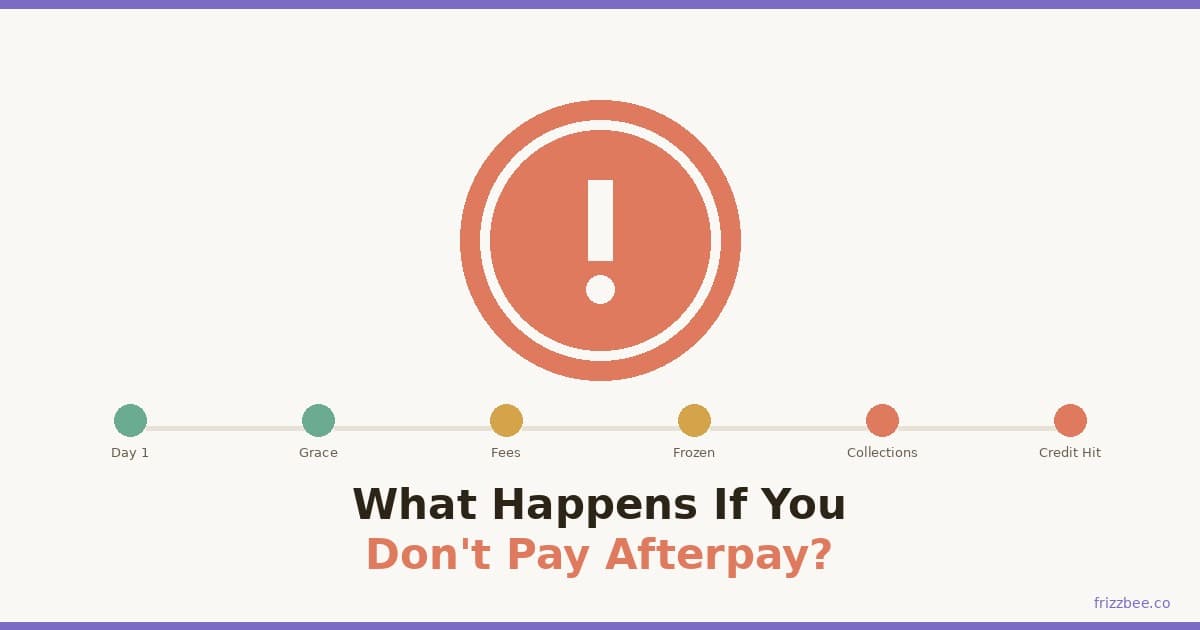
Stage 1: You Miss a Payment (Day 1)
The moment your scheduled payment fails, Afterpay takes immediate action on your account.
Your account is paused instantly. You cannot make any new purchases until you are caught up. Your spending limit may also decrease, and it can take time to rebuild even after you pay. Afterpay starts sending you notifications and emails reminding you to pay. At this point, no fee has been charged yet. You are in the grace period.
This is the easiest stage to fix. If you just forgot or the wrong card was on file, log into the Afterpay app and make the payment manually. Problem solved, no damage done.
Stage 2: The Grace Period (Days 1 Through 10)
Afterpay gives you approximately 10 days after the due date before any late fee kicks in. This is your window to make things right without it costing you extra.
During this period, your account stays frozen for new purchases, but you will not be charged a penalty if you pay before the grace period ends. Afterpay will keep sending reminders. Some users report getting daily notifications.
If money is tight, this is the time to act — not hide. You have two options most people do not know about. First, you can reschedule your payment in the app. Afterpay lets you push a payment back by a few days, up to three times per year, at no cost. Second, you can contact Afterpay support and ask about their financial hardship program. They may be able to pause your payments or work out an alternative arrangement.
Stage 3: Late Fees Start (After Day 10)
If you have not paid by the end of the grace period, the fees begin.
For orders under $40, Afterpay charges a single late fee capped at 25% of the order value. So on a $30 purchase, the maximum late fee would be $7.50.
For orders of $40 or more, the fee structure is more aggressive. You get hit with an initial $10 late fee. If the payment is still unpaid after another 7 days, an additional $7 fee is added. This pattern continues, but total late fees are always capped at 25% of the original order value or $68, whichever is lower.
Here is what that looks like in practice. Say you bought a $200 pair of headphones and missed the third installment of $50. After the grace period, you owe the $50 payment plus a $10 late fee. A week later, another $7. Your $50 payment is now $67. And if you miss the fourth installment too, those fees stack on that payment as well. The maximum total across all late fees on that $200 order would be $50 (25% of $200).
The fees are annoying, but they are predictable and capped. Afterpay cannot charge you runaway interest like a credit card can.
Stage 4: Account Restrictions Get Serious (Weeks 2 Through 8)
If you continue ignoring the payments, Afterpay escalates things beyond just fees.
Your spending limit drops significantly — often to zero. Even after you eventually pay, it can take weeks or months to rebuild. Afterpay may block your account entirely, meaning you cannot use the service at all until you clear the debt. If you have multiple overdue orders, the fees compound across each one.
At this stage, Afterpay is also making repeated attempts to charge your registered payment method. If those charges keep declining, your bank may flag the repeated failed transactions, which can cause issues with your bank or card provider independently of Afterpay.
This is still fixable. Pay your balance, and your account will be reactivated. Your limit will be lower than before, but it will gradually increase again as you demonstrate on-time payments.
Stage 5: Debt Collection (After 60 to 90 Days)
This is where things get real. If payments remain unpaid for an extended period — typically 60 to 90 days — Afterpay can refer your debt to a third-party debt collection agency.
Once a collections agency is involved, several things change. The collector will contact you by phone, email, and mail. They may be persistent. The debt may be reported to credit bureaus as a collections account. Under newer FICO scoring models, paid collections are treated more favorably, but the record can remain on your credit report for up to seven years. The collections agency may add their own fees on top of what you owed Afterpay.
This is the stage where your credit score actually gets hit. Remember, Afterpay itself does not report late payments to credit bureaus for standard Pay in 4 purchases in the US. But a collections agency absolutely will report. And a collections mark on your credit report makes it harder to get approved for credit cards, auto loans, mortgages, and sometimes even apartment rentals.
Stage 6: Long-Term Consequences
If you never pay, the collections account sits on your credit report. Under federal law, you have rights. The Fair Debt Collection Practices Act requires collectors to send you a written validation notice within five days of contacting you, and you have 30 days to dispute the debt in writing.
Afterpay is unlikely to take you to court. The amounts involved — typically under $2,000 — usually do not justify the cost of legal action. But the collections agency that bought your debt might have a different threshold. Rules also vary by state.
The lasting damage is to your credit. A collections account can make it significantly harder to borrow money at reasonable rates for years. And even after you pay the collection, older credit scoring models still penalize you for having had it.
What You Should Do Right Now
If you are reading this because you have already missed a payment, here is your action plan based on where you are.
If you are within the 10-day grace period: Pay now. Open the app, make the payment, and you will avoid the late fee entirely. If you cannot pay the full amount, reschedule the payment in the app to buy yourself a few more days.
If you have been charged a late fee but it has been less than 60 days: Pay the balance including the late fee as soon as possible. Then contact Afterpay support and politely ask if they can waive the late fee. If it is your first offense, they often will. Be honest and direct. You can also use a late fee waiver template — tools like Frizzbee's In Your Corner feature provide professionally written templates for exactly this situation.
If you are in collections: Do not ignore the collector. Respond to the validation notice, verify the debt amount is correct, and negotiate a payment plan if needed. Paying a collection in full is better than leaving it unpaid, especially under newer credit scoring models that ignore paid collections.
If you are struggling financially: Contact Afterpay directly and ask about their hardship program. They have a financial hardship policy that allows them to work with customers facing genuine difficulty. You can also reach out to a nonprofit credit counseling service for free advice.
How to Make Sure This Never Happens Again
The number one reason people miss BNPL payments is not irresponsibility — it is losing track. When your Afterpay payments are in one app, your Klarna payments are in another, and your Affirm payments are somewhere in your email, things slip through the cracks.
The fix is simple: get everything in one place. Whether that is a spreadsheet, calendar reminders, or a dedicated tracking tool like Frizzbee, having a single view of all your BNPL payments with upcoming due dates and reminder alerts eliminates the surprise factor.
Set reminders for 3 days before each payment, not the day of. Check your bank balance the night before a payment is due. And if you are carrying more than 3 or 4 active BNPL plans at once, slow down on new purchases until some are paid off. For more strategies, check out our guide on how to avoid Afterpay late fees.
The bottom line: not paying Afterpay will not ruin your life, but it will cost you money, freeze your account, and potentially damage your credit for years if it reaches collections. At every stage, acting sooner is better than acting later. And the best defense is never getting there in the first place.